Running your system
How often should you clean air conditioner filters?
Many manufacturers recommend cleaning main filters every two weeks during use. Learn why your model’s instructions matter and how to plan safe filter care.
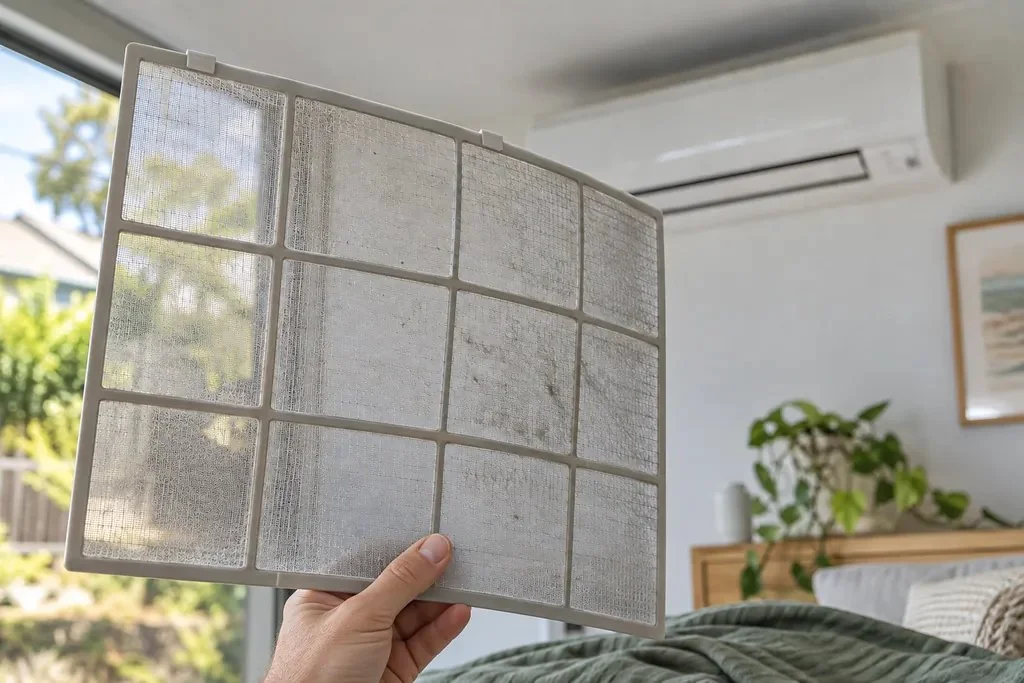
If filter cleaning has slipped off your household list, start with the instructions for your air conditioner. Many manufacturers recommend cleaning the main dust filter every two weeks during use, but different filters have different routines. Knowing which one you have helps you choose a sensible schedule and avoid washing a part that needs replacing.
Is every two weeks the right cleaning interval?
Daikin’s Australian guidance recommends cleaning indoor filters every two weeks, and more often in dusty conditions. Mitsubishi Electric also recommends a two-week interval for the main filter in its cleaning guide. Those are useful starting points, but the instructions for your exact model and filter come first.
Treat the recommended interval as a regular household reminder, rather than waiting for the room to feel stuffy. If dust builds up before the next clean is due, inspect it sooner. A cleaner-looking filter is not a reason to ignore the manufacturer’s schedule, especially if your system has a separate filter with its own maintenance requirements.
What does the filter actually do?
Your air conditioner draws room air through the indoor unit and sends it back into the room. The main dust filter catches particles in that passing air. When dust blocks it, less air can pass through, so cooling can become less effective and the system may use more electricity to cool the room.
That is why filter care matters even when the machine still switches on. It helps keep the air path clear, but it does not take the place of a service or prove the rest of the system is in good condition. There is no need to wait for a higher electricity bill to decide whether a clean is due.
How do you know which filter you have?
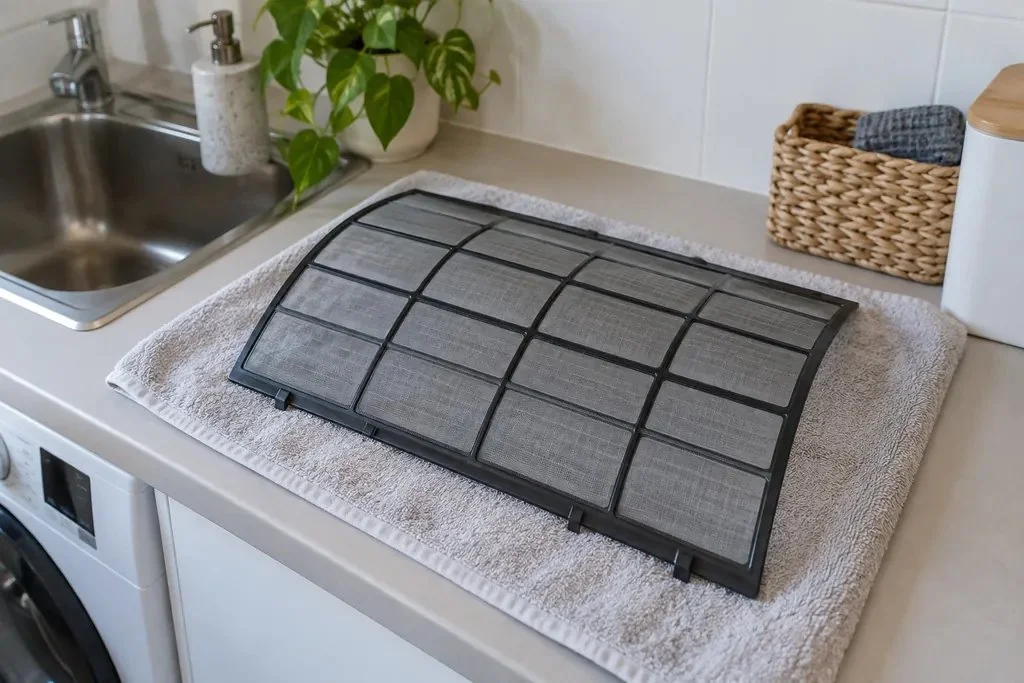
A wall-mounted split system has an indoor unit on the wall connected to an outdoor unit. Its main filter is often a removable mesh screen behind the front panel. Some models also have a smaller air-cleaning insert, designed to treat particles or odours, with different cleaning and replacement instructions.
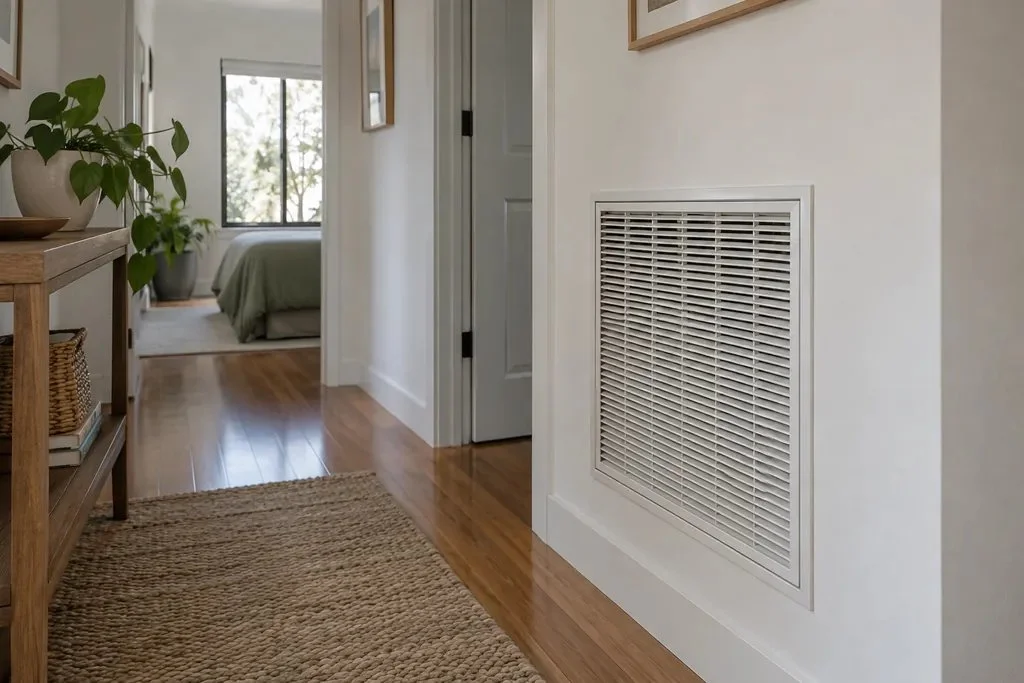
A ducted system sends air to rooms through ducts, which are passages for air. Its filter may be behind a return-air grille: the larger grille where room air is drawn back into the system, often in a hallway. That location does not mean every ducted filter is washable or intended for you to remove.
Check the maintenance section of the manual before opening a panel. Some filters can be cleaned and reused; others are disposable and need replacement. If you cannot identify yours, leave it in place and ask for help. The Mitsubishi Electric manuals and support page is one place to look for model instructions.
How can you clean an accessible filter safely?
The following is a way to organise the job, rather than instructions for opening every air conditioner. Proceed only with a filter the manual says you can maintain and only where you have safe access. If reaching it involves balancing on furniture or entering a roof space, ask us to help.
- Read the model’s filter instructions first. Switch off and isolate the power as directed before opening the permitted panel; isolation means disconnecting the electricity supply. If you are unsure how to do that safely, stop and ask for instructions.
- Remove the filter only as shown in the manual. Leave internal metal parts, wiring and other components alone.
- Use the approved cleaning method. Vacuuming or washing may be allowed for a reusable filter, but do not assume that applies to a smaller insert or a disposable filter.
- If washing is permitted, let the filter dry completely as instructed. Refit it correctly and close the panel before using the system again.
Do not spray water or cleaning chemicals into the unit. If the filter is damaged or a panel does not move as the instructions show, avoid forcing it. Confirm the correct replacement part before buying one; looking similar is not enough.
How do you make the routine fit a busy home?
Put a reminder in your phone using the interval in the manual, and note the date when you clean or replace the filter. If you notice it gets dirty earlier during daily summer use, bring the next inspection forward. That gives you a routine based on both the instructions and what is happening in your home.
If the manual lists a replacement filter reference, keep it with your maintenance notes. That saves you having to work out which part you need each time a replacement is due.
What if clean filters do not solve the problem?
If the air still feels weak or the room does not cool after the filter is correctly cleaned and refitted, there may be another cause. Our not-cooling guide explains the first checks. Stop using the unit and seek advice if it leaks water indoors, smells burnt or trips the power.
You can ask Caleb for help with filter care or a performance problem. Send a photo of the closed unit or return-air grille and the model number if you can safely find it. Tell us whether you need help identifying a filter, reaching it safely or understanding why the cooling has changed; that gives us a useful place to start.
Sources and further reading
Research checked 5 October 2026. For operation, maintenance and installation requirements, use the instructions for the exact equipment in your home.
- Mitsubishi Electric — owner filter-cleaning guidance ↗
- Mitsubishi Electric — model manuals and support ↗
- Daikin Australia — filter-cleaning frequency ↗
- Daikin Australia — reusable and replacement filters ↗
- Daikin — blocked filters and airflow ↗
- Mitsubishi Electric — MSZ-AP60–80 operating instructions (model-specific safety and controls) (PDF) ↗
Want a hand with this?
Unsure which filter you have? Send the model number and a photo of the closed unit.
Ask Caleb ↗